| Cercetare / Conferinţe / | anterior | următor |
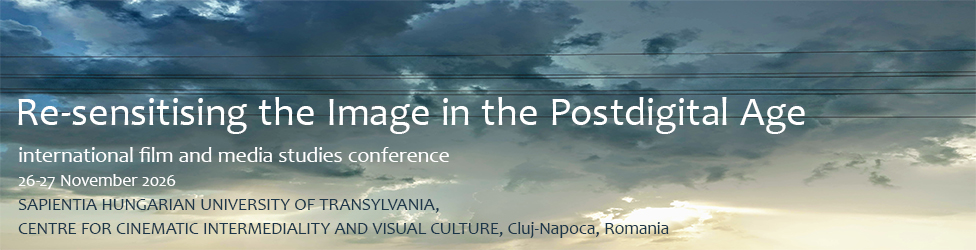
RE-SENSITISING THE IMAGE IN THE POSTDIGITAL AGE
26-27 November 2026
Sapientia Hungarian University of Transylvania, Cluj-Napoca, Romania
Centre for Cinematic Intermediality and Visual Culture
Deadline for submission: 12 July 2026
CALL FOR PAPERS
In our current postdigital condition, digital technology is so deeply embedded in everyday life that the distinction between technical and natural is becoming increasingly blurred and images have become mere byproducts of our embodied co-existence with digital media. At the same time, we see that visual forms are continuously rendered obsolete by the rapidly evolving algorithmic processes. In new media, we are no longer even looking at "the image" any more, but rather always only at a version of an image that can be infinitely modified. Cameras are regularly used to connect the eye and the machine in a way that serves no aesthetic goal, creating purely "operational images" (Harun Farocki). Furthermore, the vast majority of the images that we see today strike us not only as ephemeral or as disposable "content" fracturing our attention and inviting us to scroll through on our digital devices, they are, in the words of Hito Steyerl, "upgraded to data performance events [...] rendering warfare, marketing and surveillance as variations on the same spectrum". Their relentless multiplication and ubiquity induce exhaustion, indifference, and the numbness of the senses. Our interactions with the constant flow of visual "content" disconnects us from the world and from ourselves.
Nevertheless, in a more optimistic tone, Lev Manovich insists that contemporary society operates within flexible and varied attention regimes, rather than having its attention uniformly destroyed by technology.
Contemporary cinema often reflects on this postdigital condition and invites us to get in touch with our humanity and the everyday reality around us. The persistence of "slow cinema" or experimental documentary practices, along with all kinds of sensuous moving image installations challenges us to become not just "pensive" (Raymond Bellour, Laura Mulvey), but also sensitive and engaged spectators. This year's Venice Biennale titled In Minor Keys focuses on emotional, sensory, and subjective art that highlights intimacy, interconnectedness, and indigenous knowledge as a form of "quiet resistance" to the accelerated, dehumanizing productivity of digital capitalism.
In light of all this, we would like to ask: How can cinematic images facilitate shifting between various modes of focus? And how can cinema/moving image art reclaim the image as a unique, sensuous, affective visual experience and object of contemplation?
In this conference, we aim to explore such issues in the context of contemporary moving images and invite you to join us in friendly discussions on this topic. We welcome presentations that address any of the following questions or that propose further intriguing perspectives within this general field of inquiry:
- What kind of visual and intermedial strategies are effective in creating impactful cinematic images fostering not disengagement but sensitivity and empathy in a world that is in constant turmoil and riddled by crises?
- How does contemporary experimental art revitalise the perception of imageness, and reinstate "the image as raw, material presence" (Jacques Rancière)?
- How does immersion into mood and into a synaesthetically sensuous environment interact with reflexivity within slow cinema?
- Can the image be not only dissolved but restored through "the aesthetics of atmospheres" (Gernot Böhme, Giuliana Bruno, Tonino Griffero) in cinema, video installation art, and artistic video games?
- Can image-conscious "elemental cinema" (Tiago de Luca) bring us closer to contemplating physical reality, and increase our awareness of a more-than-human world?
- How does cinema rely not on the visible but on the imagined image?
- How can the sensuous cinematic image connect us to what cannot be seen?
- How can moving image art critically engage with key issues of contemporary visual culture, including the uncanny and desensitizing effects of AI generated imagery?
- How does analogue nostalgia bring into focus the image in the postdigital age?
- How does contemporary documentary reinvent itself on the new "groundless ground of hybridity" (Erika Balsom)?
- How do films address the phenomenon of "digital lethargy" (Tung-Hui Hu), a refusal to participate in the "attention economy" generated by digital capitalism and mass media?
- How can social re-sensitising be achieved with interdisciplinary projects at universities, films in education, and in professional training?
KEYNOTE SPEAKERS:
ERIKA BALSOM, Reader in Film and Media Studies, King's College London (UK). She is the author of five books, including After Uniqueness: A History of Film and Video Art in Circulation (2017; Russian translation 2026), TEN SKIES (2021, shortlisted for the Kraszna Krausz Prize; Korean translation forthcoming), and The Edges of Cinema: Essays on 21st Century Film Culture (2026), a collection of ten years of criticism that will be published later this year by Columbia University Press. Her writing has appeared in publications including 4Columns, Bookforum, Camera Obscura, e-flux, frieze, Film Comment, New Left Review, and Screen, as well as in numerous exhibition catalogues. She is the co-editor of four edited volumes and, with Genevieve Yue, the series editor of "Cutaways" at Fordham University Press. Her curatorial practice extends across the cinema and the gallery and includes the major survey exhibition "No Master Territories: Feminist Worldmaking and the Moving Image" (co-curated with Hila Peleg), which began at Haus der Kulturen der Welt, Berlin, in 2022 and has since toured internationally.
TIAGO DE LUCA, Reader in Film Studies, University of Warwick (UK). He is the author of Planetary Cinema: Film, Media and the Earth (2022) and Realism of the Senses in World Cinema: The Experience of Physical Reality (2014), and the co-editor of Elemental World Cinema: Cinematic Entanglements of Earth, Fire, Water and Air (2025), Towards an Intermedial History of Brazilian Cinema (2022) and Slow Cinema (2016). He is the series editor, with Lúcia Nagib, of Film Thinks: How Cinema Inspires Writers and Thinkers (Bloomsbury).
We plan this as a stimulating and mainly in-person event, therefore we encourage you to come and join us in the debates. Nevertheless, in case you cannot come, we will accept a limited number (up to 20%) of online presentations (in mixed panels).
The official language of the conference is English. The time for presentations is 20 minutes, followed by a 10-minute debate.
We plan to publish a selection of papers based on the presentations in our international, peer-reviewed journal, Acta Universitatis Sapientiae, Film and Media Studies, indexed in several international databases (e.g. Web of Science Core Collection: Emerging Sources Citation Index, ERIH Plus).
We accept proposals for individual presentations and especially welcome proposals of panels presenting the work of a research project/centre or friendly group (consisting of 3 papers).
SUBMISSION OF PROPOSALS:
Please be advised that abstracts identified as AI-generated, or suspected to have been written to a significant extent with AI assistance, will be automatically disqualified.
Send your proposals by filling in one of these forms:
Deadline: 12 July 2026.
We will notify you about our decisions regarding the proposals by: 20 July 2026. (However, you are welcome to request an earlier reply if you submit earlier than the final deadline and need it in order to apply for funding at your university.)
In case you have any additional questions, contact us at: sapientia.filmconference@gmail.com
REGISTRATION FEE:
- 120 EUR regular fee,
- 80 EUR reduced fee for: PhD/MA students, online presenters.
Registration period: 25 August and 12 September. A link for secure, online payment will be provided.
Conference venue:
Sapientia Hungarian University of Transylvania, Faculty of Sciences and Arts
400193. Cluj-Napoca, str. Calea Turzii nr. 4. ROMANIA
Travel information:
Cluj-Napoca is connected to major European hubs of air travel. See the list of available flights on the website of Cluj Napoca Airport: www.airportcluj.ro/
Low-cost flights to Cluj:
- WIZZ Air: https://www.wizzair.com/en-gb
- Ryanair: https://www.ryanair.com/gb/en
The airport is located at only 8 km from the city, so it is easy and fairly cheap to get to the center by taxi or bus.
Recommended possibilities of accommodation:
Here is a list of hotels in the vicinity of the conference venue, at a maximum distance of 15 minutes' walk.
Hotel Meteor Central***
https://hotelmeteor.ro/
Fullton Central Hotel ***
https://fulltoncentral.ro/
Hotel Transilvania ***
http://www.hoteltransilvaniacluj.ro
Hotel Confort ***
https://hotelconfort.ro/en/
DoubleTree by Hilton, Hotel Cluj - City Plaza ****
http://doubletree3.hilton.com/en/hotels/romania/doubletree-by-hilton-hotel-cluj-city-plaza
Courtyard by Marriott Cluj-Napoca Downtown ****
https://www.marriott.com/en-us/hotels/cljcy-courtyard-cluj-napoca-downtown/overview/